The short answer
- Yes — sealed Venetian plaster and Marmorino work well on bathroom and kitchen walls away from direct water.
- For showers, wet rooms and bath surrounds, choose a wet-area finish: tadelakt or microcement, over proper tanking.
- Lime is naturally mould-resistant and breathable, which helps in steamy rooms.
Bathrooms and kitchens are where people are most tempted by polished plaster — and most nervous about it. Will it cope with steam? What about splashes, grease and cleaning? The good news is that polished lime plaster can be a brilliant choice in both rooms, as long as you choose the right finish for each zone.
Why lime works well in steamy rooms
Lime plaster has two natural advantages in bathrooms and kitchens:
- It’s breathable. Lime absorbs a little moisture from the air when it’s humid and releases it as the room dries, helping to buffer condensation. Many modern paints form a plastic film that does the opposite.
- It’s alkaline. Lime has a very high pH, which discourages mould growth — a real plus in bathrooms that don’t always get enough ventilation.
Good ventilation still matters, of course. An extractor fan and an open window will help any finish last longer.
Bathrooms: think in zones
Zone 1: direct water (showers, wet rooms, bath surrounds)
Here, standard Venetian plaster isn’t the right choice, even when sealed — constant water and soap will eventually wear through the protection. Instead, use a finish designed for wet areas:
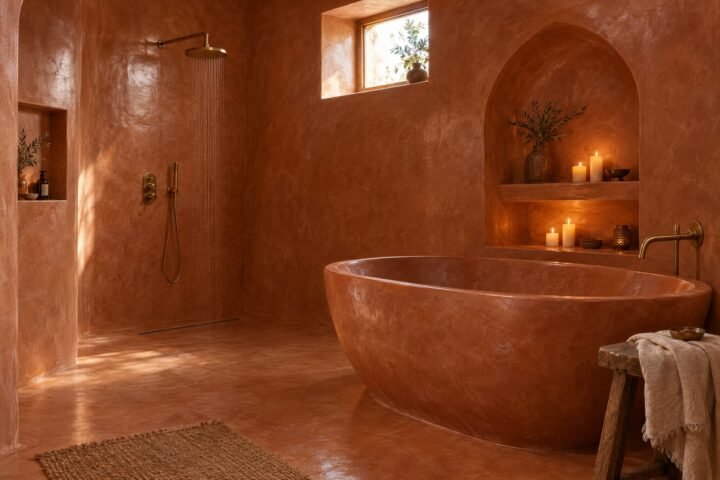
- Tadelakt — a Moroccan lime plaster polished with stones and treated with olive-oil soap to make it water-resistant. Natural, soft and sculptural. See our tadelakt guide.
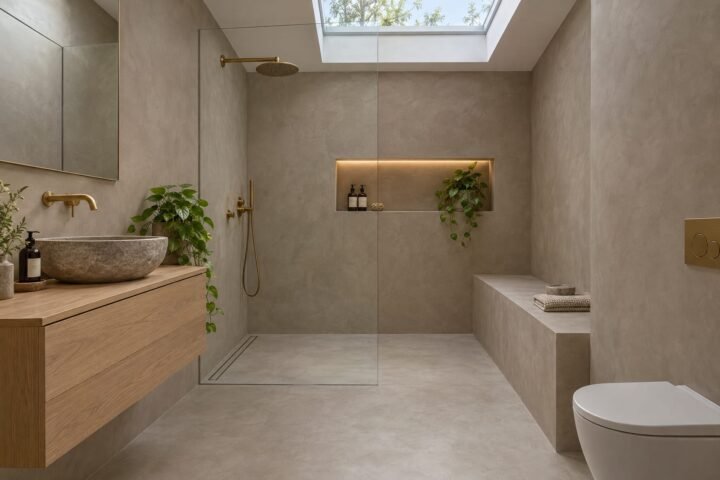
- Microcement — a thin, seamless cement coating sealed with polyurethane, suitable for walls and floors. Compare it in microcement vs tiles.
In both cases, a waterproofing (tanking) membrane must go behind the finish in showers. The decorative layer resists water; the tanking protects the structure.
Zone 2: splash areas (behind basins, around a bath, WC walls)
Sealed Venetian plaster or Marmorino can work well here, protected with a water-repellent wax or sealer. Splashes are simply wiped away. Alternatively, run microcement or tadelakt up to a sensible height and switch to polished plaster above.
Zone 3: the rest of the room
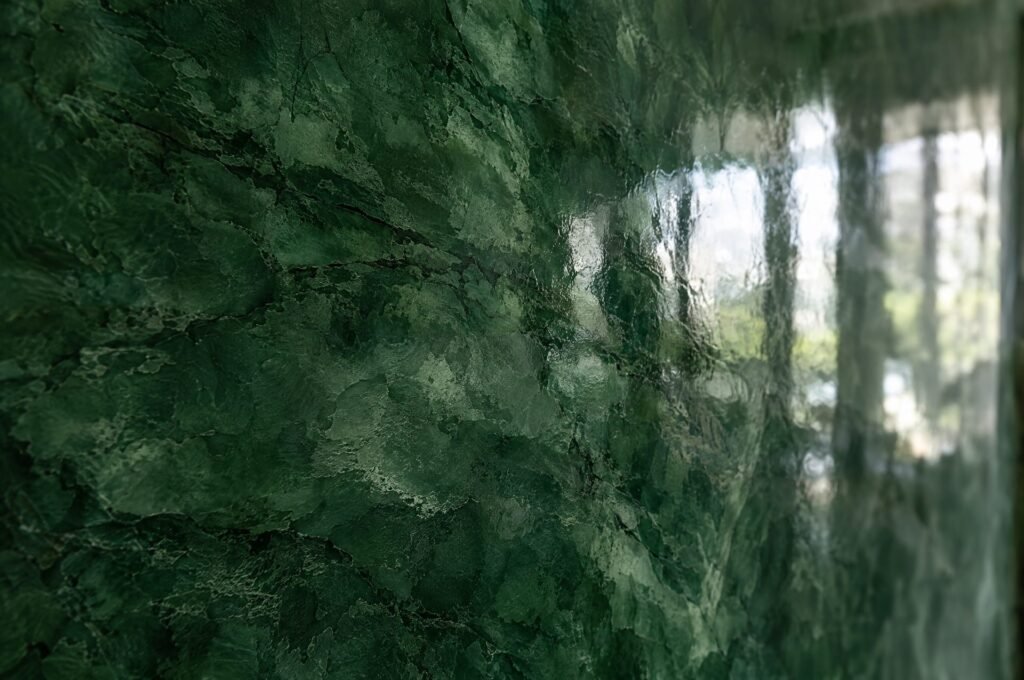
The remaining walls and ceiling are perfect for polished plaster — powder rooms and cloakrooms, in particular, are one of our favourite places for a dramatic high-gloss finish.
Kitchens: walls, splashbacks and islands
Kitchen walls
General kitchen walls are a great place for polished plaster. A sealed or waxed finish copes with normal cooking humidity and can be wiped clean.
Splashbacks
Splashbacks take more punishment: heat, grease, tomato sauce, frequent wiping. Behind a sink, a well-sealed polished plaster or microcement splashback can work. Directly behind a hob, we usually recommend microcement with a hard-wearing sealer — or a glass panel over polished plaster so you keep the look with extra protection.
Islands, worktops and floors
For islands, worktops and kitchen floors, microcement is the right material. It’s tougher underfoot and can be sealed for food areas. Our microcement floors guide explains how it performs day to day.
How to protect polished plaster in wet-ish rooms
- Choose the right sealer. Natural waxes deepen colour and repel splashes; breathable sealers add extra protection in kitchens.
- Clean gently. A soft cloth with a little pH-neutral soap. Never use bleach sprays, limescale removers, vinegar or abrasive pads — acids and abrasives damage lime.
- Wipe up quickly. Don’t leave toothpaste, cosmetics or cooking spills to sit.
- Re-wax occasionally. Every few years in busy areas, to keep the protective layer strong.
More detail in our guide to how long Venetian plaster lasts and how to care for it.
A typical seamless bathroom combination
A popular seamless bathroom scheme looks like this:
- Microcement floor throughout, with anti-slip sealer
- Tadelakt or microcement inside the shower enclosure, over tanking
- Sealed Marmorino or satin Venetian plaster on the remaining walls
- A polished plaster ceiling, if you want to go all the way
The result is a calm, joint-free room that feels like a boutique hotel — and is easier to clean than a tiled bathroom.
Ask us about your space
Every bathroom and kitchen is different, so the best advice comes from seeing it. We’ll visit for free, check ventilation and substrates, and bring sample boards — anywhere in London and the Home Counties. Get in touch.

We apply Venetian plaster, Marmorino, tadelakt and microcement across London and the Home Counties. More about us · Get a free quote