The short answer
- Venetian plaster is a decorative wall finish made mainly from slaked lime and finely ground marble, tinted with mineral pigments.
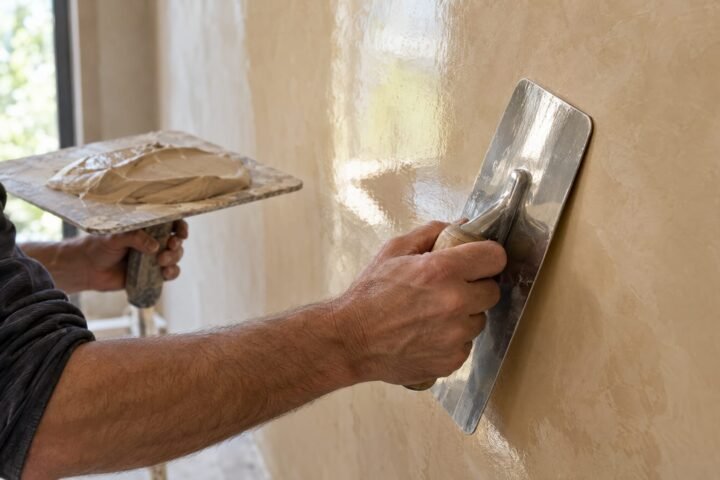
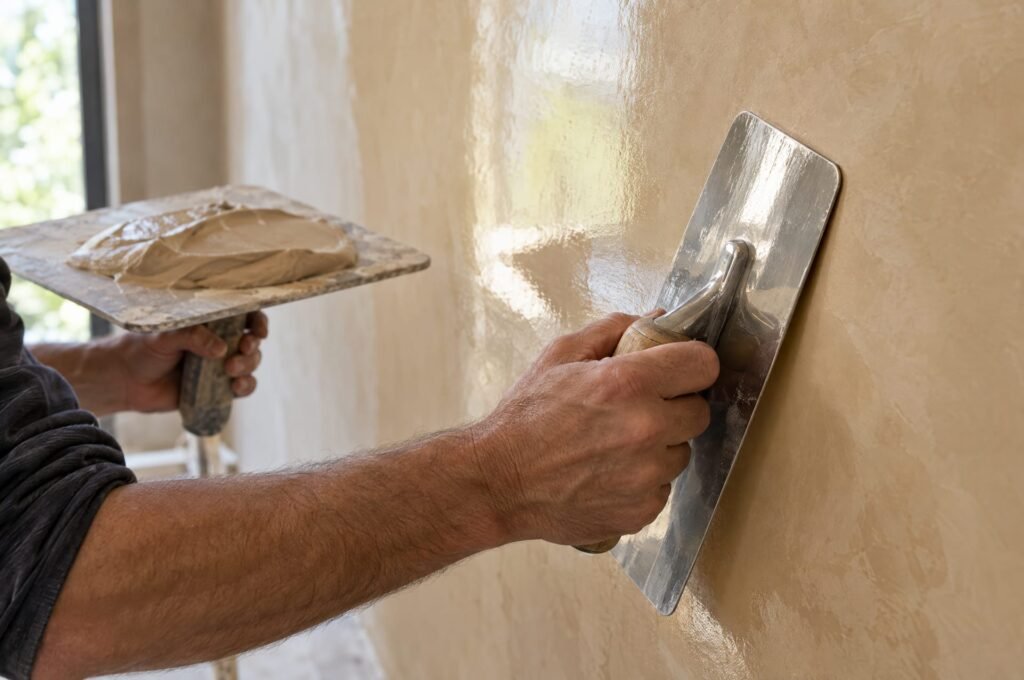
- It’s applied by hand in several very thin coats, then burnished with a steel trowel to create depth and sheen.
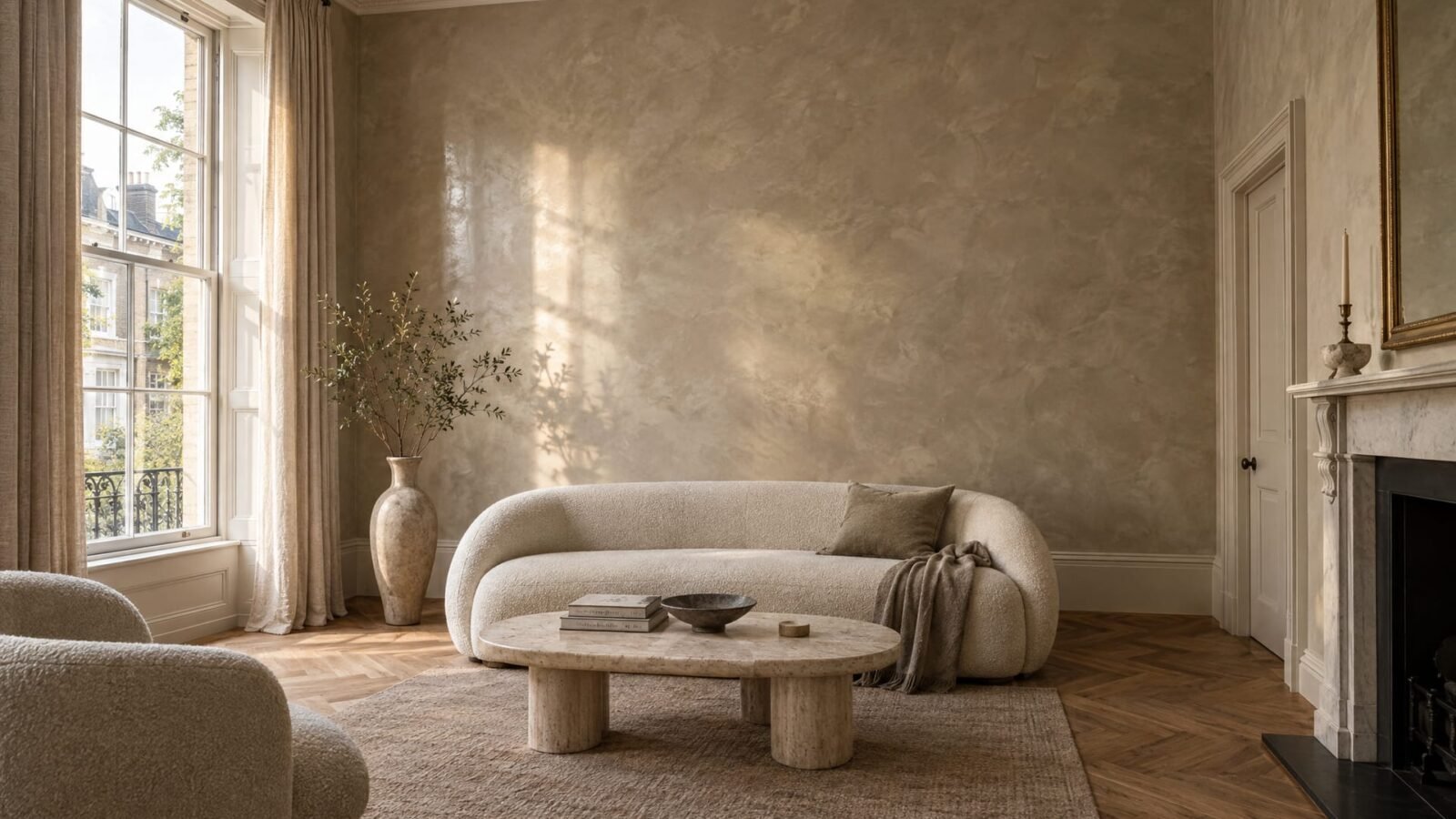
- Finishes range from soft matt Marmorino to mirror-like high-gloss stucco veneziano.
- It’s breathable, naturally mould-resistant, seamless and — when properly prepared — lasts for decades.
If you’ve ever stood in a hotel lobby, a restaurant or a friend’s hallway and found yourself running your hand along a wall that seemed to glow from the inside, there’s a good chance you were looking at Venetian plaster. It is one of the most beautiful finishes you can put on a wall — and one of the most misunderstood.
This guide explains, without jargon, what Venetian plaster actually is, how it’s made and applied, the different types, and whether it’s right for your home.
Where Venetian plaster comes from
Lime plasters have been used for thousands of years — the Romans were masters of them. But the finish we now call Venetian plaster is most closely associated with Venice, where builders needed wall finishes that could cope with a damp, salty lagoon climate while still looking magnificent. Lime and marble dust, both readily available, were ideal: breathable, durable and beautiful.
During the Renaissance, polished lime finishes became a hallmark of Venetian palazzi and villas in the Veneto. The techniques were refined over centuries and are still used — largely unchanged — today.
What is Venetian plaster made of?
Traditional Venetian plaster has three main ingredients:
- Slaked lime (lime putty) — limestone that has been burnt, then combined with water and left to mature. It’s the binder.
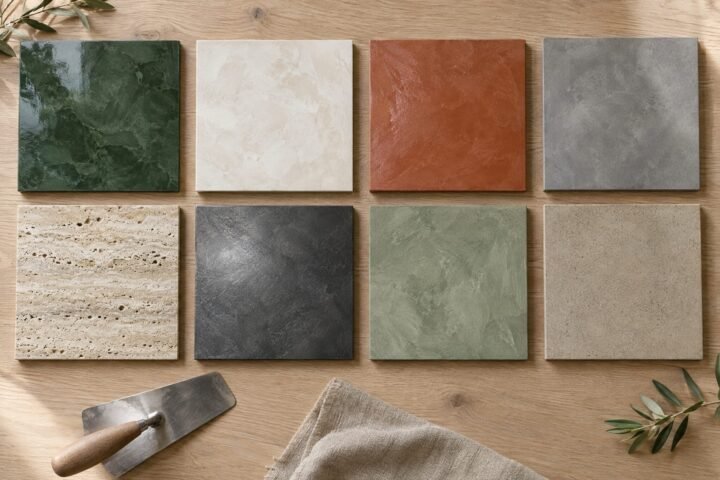
- Marble dust — finely crushed marble that gives body, hardness and that stone-like depth. The size of the grain affects the finish: finer for gloss, coarser for Marmorino.
- Pigments — usually natural earth or mineral oxide pigments, which are stable in lime.
Here’s the clever part: as lime plaster dries, it absorbs carbon dioxide from the air and gradually turns back into calcium carbonate — effectively limestone. That’s why a lime finish keeps hardening for months after it’s applied, and why it can last so long.
You’ll also find acrylic or synthetic “Venetian plasters”. These imitate the look using plastic resins and are sometimes useful in specific situations, but they don’t breathe like lime and don’t develop quite the same depth. A good applicator will always tell you which product they’re using and why.
How Venetian plaster is applied
Unlike paint, Venetian plaster can’t be rolled or sprayed. It’s built up by hand:
- Preparation — the wall must be sound, flat and dry. Cracks are filled, uneven areas skimmed, and a primer applied to help the plaster grip.
- First coats — thin layers are trowelled on in overlapping, multi-directional strokes and left to dry.
- Finishing coats — final layers are applied even more thinly, then pressed hard with a stainless steel trowel. This compresses the marble and lime, closing the surface and creating the polish.
- Protection — a wax or breathable sealer is applied to protect the surface and deepen the colour.
A high-gloss finish typically involves three or four coats plus wax; a softer finish may need only two or three. Each coat needs time to dry, which is why even a single feature wall usually takes two to three days.
The main types of Venetian plaster
“Venetian plaster” is really an umbrella term. The finishes you’re most likely to come across in a London home are:
- Stucco veneziano — the classic, highly polished finish with a deep, marble-like gloss. See our Venetian plastering service.
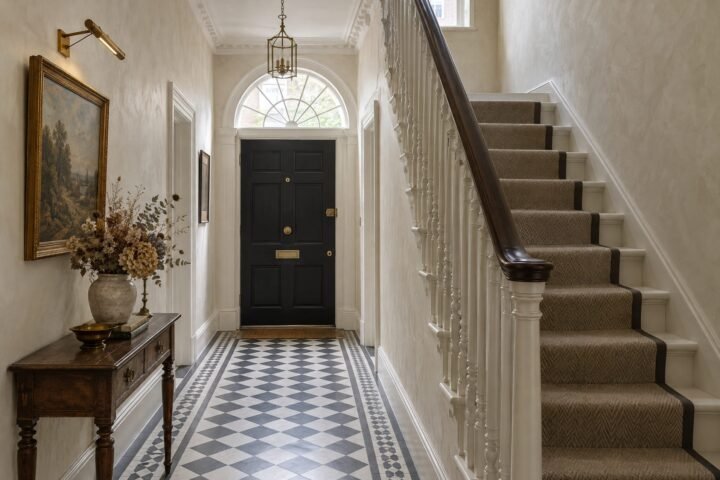
- Marmorino — a slightly coarser marble plaster with a matt-to-satin, stone-like finish. Superb in hallways and period homes — see Marmorino plaster.
- Grassello — a smooth finish based on very fine, aged lime putty, often polished to a soft sheen.
- Metallic and textured variants — finishes with metallic glazes, travertine-style texture or crackle effects. See textured finishes.
The difference between the two most popular choices is explained in detail in Marmorino vs stucco veneziano.
Venetian plaster vs paint
| Venetian plaster | Paint | |
|---|---|---|
| Look | Depth, movement and sheen that changes with the light | Flat, uniform colour |
| Breathability | Lime is vapour-permeable | Many modern paints are not |
| Durability | Hardens over time; lasts decades | Typically repainted every few years |
| Repairs | Small marks can be filled and re-burnished | Touch-ups often show; whole wall repainted |
| Cost | Significantly higher upfront | Low |
| Application | Specialist, hand-applied over several days | Quick; DIY-friendly |
Where does Venetian plaster work best?
Almost anywhere indoors. Feature walls behind beds and sofas, entrance halls and stairwells, dining rooms, curved walls and ceilings are all classic uses. Sealed polished plaster also works on bathroom walls away from direct water — read can you use Venetian plaster in bathrooms and kitchens? For showers and wet rooms, look at tadelakt or microcement instead.
Venetian plaster is particularly well suited to London’s many Victorian, Edwardian and Georgian homes. Their solid brick walls need to “breathe”, and lime lets moisture escape where many modern paints trap it.
Pros and cons
Advantages
- Unmatched depth and beauty — every wall is unique
- Breathable and naturally mould-resistant
- Seamless, with no joints or panels
- Extremely long-lasting with simple care
- Repairable rather than disposable
Things to consider
- Higher upfront cost than paint — see our London cost guide
- Takes several days because each coat must dry
- Needs a sound, well-prepared wall — it will follow structural movement
- Not suitable for direct water exposure unless you choose a wet-area system
How long does it last?
Properly prepared and applied, genuine lime plaster can last for decades — and in Venice, buildings still wear plaster applied centuries ago. Care is simple: dust it or wipe it with a soft, damp cloth and mild soap. Our guide to how long Venetian plaster lasts covers cleaning, waxing and repairs.
Is Venetian plaster right for you?
If you want walls with genuine depth and character, love natural materials and plan to enjoy your home for years, Venetian plaster is hard to beat. The best way to decide is to see it in person: we bring real sample boards to every free survey across London and the Home Counties.

We apply Venetian plaster, Marmorino, tadelakt and microcement across London and the Home Counties. More about us · Get a free quote